3d molecular orbital drawing for ch3chch2
Pictorial Molecular Orbital Theory
- Page ID
- 55214
The Molecular Orbital Theory, initially developed by Robert South. Mullikan, incorporates the wave similar characteristics of electrons in describing bonding behavior. In Molecular Orbital Theory, the bonding betwixt atoms is described equally a combination of their atomic orbitals. While the Valence Bond Theory and Lewis Structures sufficiently explain unproblematic models, the Molecular Orbital Theory provides answers to more than complex questions. In the Molecular Orbital Theory, the electrons are delocalized. Electrons are considered delocalized when they are not assigned to a particular atom or bail (as in the case with Lewis Structures). Instead, the electrons are "smeared out" across the molecule. The Molecular Orbital Theory allows 1 to predict the distribution of electrons in a molecule which in plough can help predict molecular properties such as shape, magnetism, and Bond Gild.
Introduction
Atoms course bonds by sharing electrons. Atoms tin share ii, iv, or vi electrons, forming unmarried, double, and triple bonds respectively. Although it is impossible to determine the exact position of an electron, information technology is possible to calculate the probability that one will discover the electron at any point around the nucleus using the Schrödinger Equation. This equation can help predict and determine the energy and spatial distribution of the electron, as well as the shape of each orbital. The figure below shows the beginning v solutions to the equation in a three dimensional space for a 1 electron atom. The colors bear witness the phase of the function. In this diagram, bluish stands for negative and red stands for positive. Note, withal, that the 2s orbital has two phases, one of which is non visible because it is inside the other.

Figure 1: Cartoons of the volume occupied by electrons in the 1s, 2s, and 2p hydrogen-similar orbitals.
Principles of Molecular Orbital Theory
In molecules, atomic orbitals combine to course molecular orbitals which surroundings the molecule. Similar to atomic orbitals, molecular orbitals are wave functions giving the probability of finding an electron in certain regions of a molecule. Each molecular orbital can only take two electrons, each with an opposite spin. Each molecular orbital can only have 2 electrons, each with an opposite spin. Once you lot have the molecular orbitals and their energy ordering the ground state configuration is found by applying the Pauli principle, the aufbau principle and Hund's rule but as with atoms.
The principles to apply when forming pictorial molecular orbitals from diminutive orbitals are summarized in the tabular array below:
| Principle | Details/Examples |
|---|---|
| Total number of molecular orbitals is equal to the full number of atomic orbitals used to brand them. | The molecule Htwo is composed of ii H atoms. Both H atoms take a 1s orbital, so when bonded together, there are therefore ii molecular orbitals. |
| Bonding molecular orbitals are lower energy than the atomic orbitals from which they were formed. Antibonding molecular orbitals are higher energy than the atomic orbitals from which they were formed. | Electrons in bonding molecular orbitals aid stabilize a arrangement of atoms since less energy is associated with bonded atoms as opposed to a system of unbound atoms. Bonding orbitals are formed by in-phase combinations of atomic orbitals and increase the electron density betwixt the atoms (see figure 2 below) Electrons in antibonding molecular orbitals cause a system to exist destabilized since more free energy is associated with bonded atoms than that of a organisation of unbound atoms. Antibonding orbitals are formed by out-of-phase combinations of atomic orbitals and decrease the electron density betwixt atoms (see effigy ii beneath). |
| Following both the Pauli exclusion principle and Hund's dominion, electrons fill in orbitals of increasing energy. | Electrons fill orbitals with the everyman energy first. No more than 2 electrons can occupy 1 molecular orbital at a time. Furthermore, all orbitals at an energy level must exist filled with one electron before they tin exist paired. (run into effigy 3 beneath) |
| Molecular orbitals are best formed when composed of Atomic orbitals of similar energies. | When Li2 forms the two lowest energy orbitals are the pair of bonding and antibonding orbitals formed from the ii possible combinations of the 1s on each atom. The 2s orbitals combine primarily with each other to grade another pair of bonding and antibonding orbitals at a higher energy. |
Effigy 2 (beneath) shows how bonding and antibonding σ orbitals can be formed by combining s orbitals in-phase (bonding, lesser) and out-of-phase (antibonding, meridian). If the atomic orbitals are combined with the same phase they interfere constructively and a bonding orbital is formed. Bonding molecular orbitals have lower energy than the atomic orbitals from which they were formed. The lowering of the energy is attributed to the increment in shielding of the nuclear repulsion because of the increase in electron density betwixt the nuclei. If the diminutive orbitals are combined with different phases, they interfere destructively and an antibonding molecular orbital is formed. Antibonding molecular orbitals have a college energy than the atomic orbitals from which they were formed. The higher energy is attributed to the reduced shielding of the nuclear repulsion because of the lower electron probability density between the nuclei.
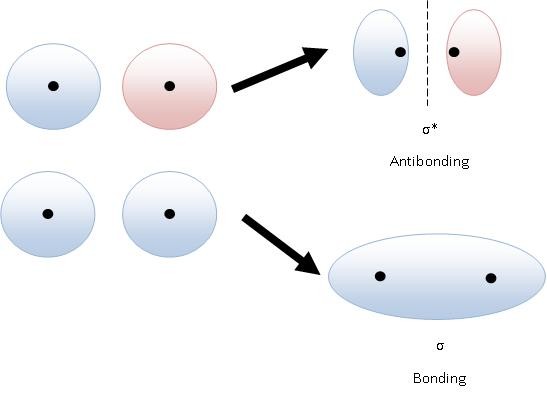
Figure 2: Combining hydrogen-like s orbitals to generate bonding (bottom) and antibonding (top) orbitals. The night dot represents the location of the nucleus. Note the decrease in electron density between the nuclei in the antibonding orbital.
\(\sigma\) Bonds
Molecular orbitals that are symmetrical about the centrality of the bail are called sigma molecular orbitals, often abbreviated by the Greek letter \(\sigma\). Figure 2 shows the 1s orbitals of 2 Hydrogen atoms forming sigma orbitals. In that location are two types of sigma orbitals formed, antibonding sigma orbitals (abbreviated \(\sigma^*\)), and bonding sigma orbitals (abbreviated \(\sigma\)). In sigma bonding orbitals, the in stage diminutive orbitals overlap causing an increase in electron density forth the bond axis. Where the atomic orbitals overlap, there is an increase in electron density and therefore an increment in the intensity of the negative charge. This increment in negative accuse causes the nuclei to be fatigued closer together. In sigma antibonding orbitals (\(\sigma^*\)), the out of stage 1s orbitals interfere destructively which results in a low electron density between the nuclei every bit seen on the height of the diagram.
The diagram below (figure 3) is a representation of the free energy levels of the bonding and antibonding orbitals formed in the hydrogen molecule. Ii molecular orbitals were formed: i antibonding (\(\sigma^*\)) and one bonding (\(\sigma\)).The ii electrons in the hydrogen molecule accept antiparallel spins. Detect that the \(\sigma^*\) orbital is empty and has a higher energy than the \(\sigma\) orbital.
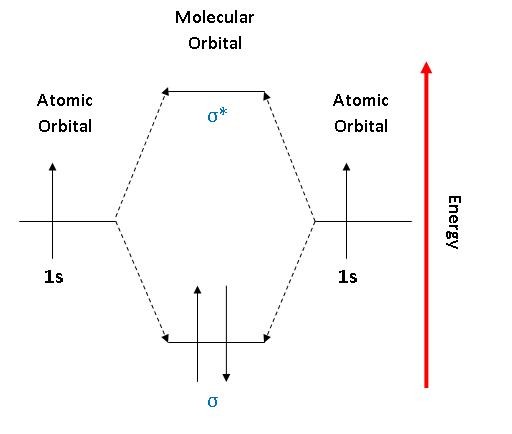
Figure 3: An MO energy level diagram for H2. The up and downward arrows represent electrons that are spin upward or spin down.
Sigma bonding orbitals and antibonding orbitals can besides be formed between p orbitals (figure 4). Notice that the orbitals have to be in phase in lodge to form bonding orbitals. Sigma molecular orbitals formed past p orbitals are often differentiated from other types of sigma orbitals past calculation the subscript p beneath it. So the antibonding orbital shown in the diagram beneath would be σ*p.
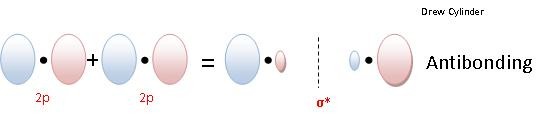

Figure four: The formation of a σ bonding and antibonding orbital using p-orbitals.
\(\pi\) Bonds
The \(\pi\) bonding is a side to side overlap of orbitals, which then causes there to be no electron density along the centrality, just there is density above and below the axis. The diagram beneath (figure 5) shows a \(\pi\) antibonding molecular orbital and a \(\pi\) bonding molecular orbital.
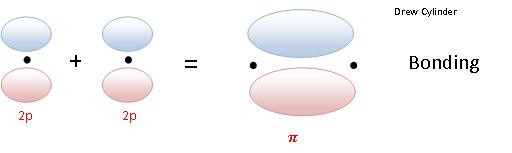
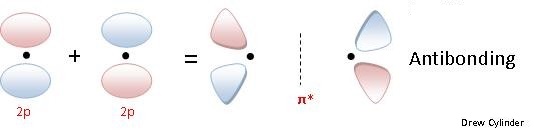
Figure 5: The side on overlap of p orbitals to form pi bonding and antibonding orbitals. Note that there is a second set of p orbitals sticking in and out of the epitome that tin combine in the same mode. (run into cartoons immediately beneath)
2py Orbitals
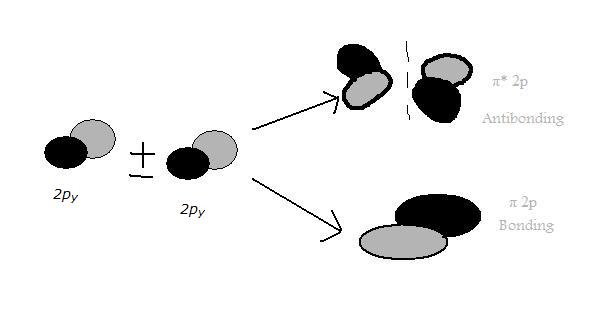
The two 2py atomic orbitals overlap in parallel to course ii \(\pi\) molecular orbitals which are asymmetrical about the centrality of the bond.
2pz orbitals
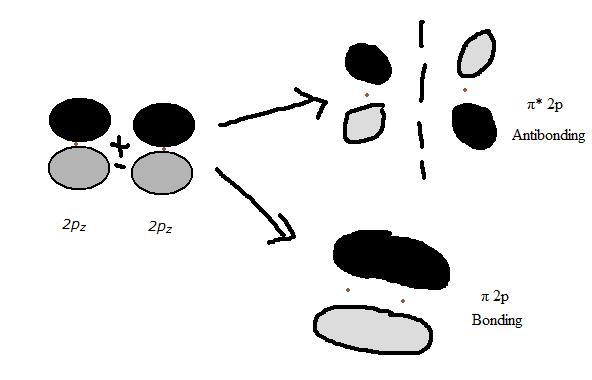
The two 2pz orbitals overlap to create another pair of pi 2p and pi *2p molecular orbitals. The 2pz-2pz overlap is similar to the 2py-2py overlap because information technology is just the orbitals of the 2pz rotated 90 degrees about the axis. The new molecular orbitals have the same potential energies every bit those from the 2py-2py overlap.
In summary the three pairs of p orbitals can combine to form one set of \sigma\ orbitals and 2 sets of \pi\ orbitals.
Drawing Molecular Orbital Diagrams
- Determine how many valence electrons you take on each atom (yous can ignore the core electrons equally core orbitals contribute fiddling to molecular orbitals). This gives you lot the total number of electrons you will take to distribute amid the molecular orbitals you form. For instance consider B2 (each atom has an electron configuration of [He]2s22p), which has a full of half dozen valence electrons.
- Depict a drawing energy level diagram with lines for the valence diminutive free energy levels (orbitals) of each cantlet. Put one cantlet'southward levels on the left and ane on the right. Include the electrons. Leave infinite in the centre for your molecular free energy levels (orbitals). It can assist to include cartoons of the atomic orbitals as well. Shown for diboron immediately beneath.
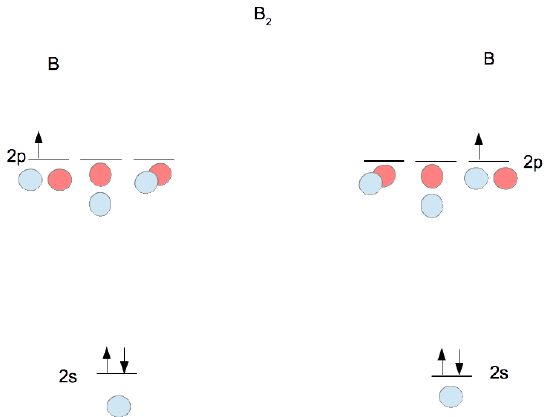
- Combine each pair of orbitals of similar energy in-stage and out-of-stage to create molecular orbitals equally shown for diboron in the effigy following step iv.
- Move the electrons from the atoms into the molecule to determine the molecular electron configuration as shown immediately beneath
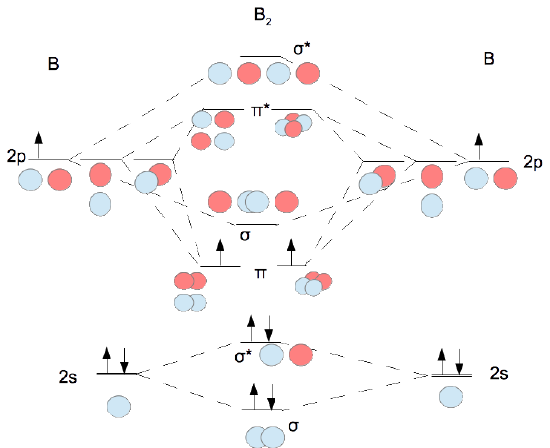
Note that the σ and π orbitals formed from the p'due south are non always in the gild π energy less than σ energy. For first row diatomics the ordering shown above is valid for Z ≤ 7. Thus for oxygen and fluorine the σ is below the π orbitals.
Bond Orders and Stability of Molecules
Bond Order indicates the force of the bond with the greater the bail gild, the stronger the bail.
\[\text{Bond Order}= \dfrac{one}{2} \left(a-b\correct)\]
where
- \(a\) is the number of electrons in bonding molecular orbitals and
- \(b\) is the number of electrons in antibondng molecular orbitals.
If the bond order is zippo, then no bonds are produced and the molecule is not stable (for example \(He_2\)). If the Bond Gild is 1, then it is a unmarried covalent bond. The higher the Bond Club, the more stable the molecule is. An advantage of Molecular Orbital Theory when it comes to Bond Social club is that it can more than accurately draw partial bonds (for example in H2 +, where the Bond Order=one/2), than Lewis Structures.
References
- Petrucci, RH et al. (2007). General Chemical science: Principles and Modern Applications. New Jersey: Pearson Prentice Hall.
- Dingrando, Laurel, Kathleen Tallman, Nicholas Hainen, and Cheryl Wistrom. Chemical science. Glencoe/McGraw-Hill School Pub Co, 2004.
-
Kotz, John C., Paul M. Treichel, and Gabriela C. Weaver. "Bonding and Molecular Structure:Orbital Hybridization and Molecular Orbitals." Chemistry & Chemic Reactivity. Belmont, CA: Thomson Brooks/Cole, 2006. 457-66. Print.
Problems
- What is the molecular orbital diagram for for the diatomic hydrogen molecule, Htwo? How stable is the molecule? Is it diamagnetic or paramagnetic?
- What is the molecular orbital diagram for the diatomic helium molecule, He2? How stable is the molecule? Diamagnetic or paramagnetic?
- What is the molecular orbital diagram for the diatomic oxygen molecule, O2? How stable is the molecule? Diamagnetic or paramagnetic?
- What is the molecular orbital diagram for the diatomic neon molecule, Ne2? How stable is the molecule? Diamagnetic or paramagnetic?
- What is the molecular orbital diagram for the diatomic fluorine molecule, F2? How stable is the molecule? Diamagnetic or paramagnetic?
Solutions
ane. The molecular orbital diagram for a diatomic hydrogen molecule, H2, is
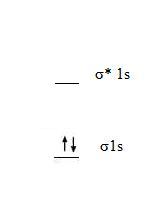
- Bond Social club = i/2(2 - 0) = 1
- The bond club higher up zero, and so H2 is stable.
- Considering in that location are no unpaired electrons, H2 is diamagnetic.
2. The molecular orbital diagram for a diatomic helium molecule, He2, shows the following.
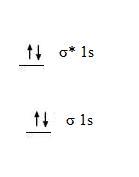
- Bond Order = 1/2(ii - 2) = 0
- bail order is zero then molecule is unstable.
- would be diamagnetic.
3. The molecular orbital diagram for a diatomic oxygen molecule, O2, is

- Bail Order = 1/2(10 - half dozen) = ii
- The bond order is two so the molecule is stable.
- There are two unpaired electrons, so molecule is paramagnetic.
four.The molecular orbital diagram for a diatomic Neon molecule, Neii, is
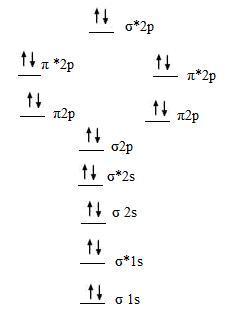
- Bond Order = i/two(x - 10) = 0
- bail order is zero, then Neii is unstable.
- diamagnetic
v. The molecular orbital diagram for the diatomic fluorine molecule, F2 is
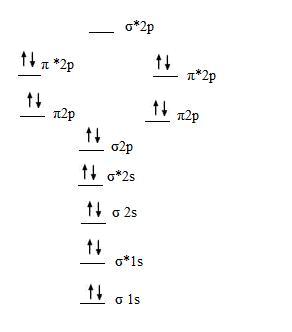
- B.O. = i/2(10 - 8) = 1
- B.O is one then the fluorine molecule is stable.
- Because all of the electrons are paired, F2 is diamagnetic.
Source: https://chem.libretexts.org/Bookshelves/Physical_and_Theoretical_Chemistry_Textbook_Maps/Supplemental_Modules_%28Physical_and_Theoretical_Chemistry%29/Chemical_Bonding/Molecular_Orbital_Theory/Pictorial_Molecular_Orbital_Theory
0 Response to "3d molecular orbital drawing for ch3chch2"
Post a Comment