Draw a 6 Hour Travel Time Circle Around Osceola Wisconsin
In rails ship, a train is a series of continued vehicles that run along a railway track and transport people or freight. The discussion train comes from the Old French trahiner , derived from the Latin trahere significant "to pull, to draw".[1] Trains are typically pulled or pushed by locomotives (often known simply as "engines"), though some are self-propelled, such as multiple units. Passengers and cargo are carried in railroad cars, besides known every bit wagons. Trains are designed to a certain gauge, or distance between rail. Near trains operate on steel tracks with steel wheels, the depression friction of which makes them more efficient than other forms of transport.
Trains take their roots in wagonways, which used railway tracks and were powered by horses or pulled past cables. Following the invention of the steam locomotive in the U.k. in 1804, trains speedily spread around the world, allowing freight and passengers to move over land faster and cheaper than ever possible earlier. Rapid transit and trams were first congenital in the late 1800s to transport large numbers of people in and around cities. Beginning in the 1920s, and accelerating following World War II, diesel fuel and electric locomotives replaced steam as the means of motive power. Following the evolution of cars, trucks, and extensive networks of highways which offered greater mobility, as well as faster airplanes, trains declined in importance and market share, and many rail lines were abandoned. The spread of buses led to the closure of many rapid transit and tram systems during this time as well.
Since the 1970s, governments, environmentalists, and train advocates take promoted increased apply of trains due to their greater fuel efficiency and lower greenhouse gas emissions compared to other modes of land transport. High-speed rail, kickoff built in the 1960s, has proven competitive with cars and planes over short to medium distances. Commuter rail has grown in importance since the 1970s as an alternative to congested highways and a means to promote development, as has light rail in the 21st century. Freight trains remain important for the ship of bulk bolt such equally coal and grain, as well equally beingness a means of reducing road traffic congestion by freight trucks.
While conventional trains operate on relatively flat tracks with 2 rail, a number of specialized trains exist which are significantly dissimilar in their mode of functioning. Monorails operate on a single rail, while funiculars and rack railways are uniquely designed to traverse steep slopes. Experimental trains such as high speed maglevs, which use magnetic levitation to float to a higher place a guideway, are under development in the 2020s and offer college speeds than even the fastest conventional trains. Development of trains which use alternative fuels such as natural gas and hydrogen is another 21st century development.
History
Early on history

Stockton and Darlington special inaugural train 1825: vi wagons of coal, directors double-decker, and then people in wagons
Trains are an evolution of wheeled wagons running on stone wagonways, the earliest of which were built past Babylon circa 2,200 BCE.[2] Starting in the 1500s, wagonways were introduced to haul material from mines; from the 1790s, stronger iron rails were introduced.[2] Post-obit early developments in the second half of the 1700s, in 1804 a steam locomotive built past British inventor Richard Trevithick powered the first ever steam railroad train.[3] Exterior of coal mines, where fuel was readily available, steam locomotives remained untried until the opening of the Stockton and Darlington Railway in 1825. British engineer George Stephenson ran a steam locomotive named Locomotion No. 1 on this twoscore-kilometer (25-mile) long line, hauling over 400 passengers at upward to xiii kilometers per 60 minutes (eight mph). The success of this locomotive, and Stephenson's Rocket in 1829, convinced many of the value in steam locomotives, and inside a decade the stock market bubble known every bit "Railway Mania" started across the Uk.[4]
News of the success of steam locomotives speedily reached the Usa, where the first steam railroad opened in 1829.[five] American railroad pioneers soon started manufacturing their own locomotives, designed to handle the sharper curves and rougher runway typical of the country's railroads.[6]
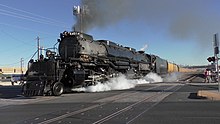
The other nations of Europe also took notation of British railroad developments, and most countries on the continent constructed and opened their offset railroads in the 1830s and 1840s, following the first run of a steam train in France in late 1829.[7] In the 1850s, trains continued to expand beyond Europe, with many influenced by or purchases of American locomotive designs.[7] Other European countries pursued their ain distinct designs. Around the earth, steam locomotives grew larger and more than powerful throughout the residue of the century as technology advanced.[viii]
Trains first entered service in South America, Africa, and Asia through construction past imperial powers, which starting in the 1840s built railroads to solidify control of their colonies and transport cargo for export.[9] In Nippon, which was never colonized, railroads get-go arrived in the early 1870s. Past 1900, railroads were operating on every continent besides uninhabited Antarctica.[10]
New technologies
Even as steam locomotive technology continued to improve, inventors in Frg started work on alternative methods for powering trains. Werner von Siemens congenital the first railroad train powered by electricity in 1879, and went on to pioneer electric trams.[8] Another German inventor, Rudolf Diesel, synthetic the first diesel fuel engine in the 1890s, though the potential of his invention to power trains was not realized until decades afterwards.[8] Betwixt 1897 and 1903, tests of experimental electric locomotives on the Royal Prussian Military machine Railway in Germany demonstrated they were feasible, setting speed records in excess of 160 kilometers per 60 minutes (100 mph).[11]

The EMD FT set the phase for diesel fuel locomotives to accept over from steam.
Early on gas powered "doodlebug" self-propelled railcars entered service on railroads in the first decade of the 1900s.[12] Experimentation with diesel and gas power continued, culminating in the German language "Flight Hamburger" in 1933, and the influential American EMD FT in 1939.[13] These successful diesel locomotives showed that diesel power was superior to steam, due to lower costs, ease of maintenance, and better reliability.[14] Meanwhile, Italy developed an all-encompassing network of electric trains during the commencement decades of the 20th century, driven by that state's lack of significant coal reserves.[11]
Dieselization and increased competition
World War II brought bully destruction to existing railroads across Europe, Asia, and Africa. Following the war's conclusion in 1945, nations which had suffered extensive damage to their railroad networks took the opportunity provided by Marshall Programme funds (or economical assistance from the USSR and Comecon, for nations backside the Atomic number 26 Curtain) and advances in applied science to convert their trains to diesel or electric ability.[15] France, Russia, Switzerland, and Japan were leaders in adopting widespread electrified railroads, while other nations focused primarily on dieselization.[16] Past 1980, the bulk of the world's steam locomotives had been retired, though they connected to be used in parts of Africa and Asia, along with a few holdouts in Europe and South America.[17] China was the final country to fully dieselize, due to its abundant coal reserves; steam locomotives were used to haul mainline trains every bit late as 2005 in Inner Mongolia.[18]
Trains began to face strong competition from automobiles and freight trucks in the 1930s, which greatly intensified following World War Two.[19] Afterward the war, air send also became a significant competitor for passenger trains. Big amounts of traffic shifted to these new forms of transportation, resulting in a widespread decline in train service, both freight and passenger.[16] A new development in the 1960s was high-speed rail, which runs on dedicated rights of mode and travels at speeds of 240 kilometers per hr (150 mph) or greater. The first high-speed rail service was the Japanese Shinkansen, which entered service in 1964.[20] In the following decades, loftier speed rails networks were developed beyond much of Europe and Eastern asia, providing fast and reliable service competitive with automobiles and airplanes.[xx] The first loftier-speed train in the Americas was Amtrak's Acela in the United States, which entered service in 2000.[21]
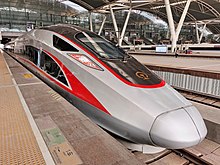
China operates an all-encompassing high speed runway network
To the present twenty-four hour period
Towards the end of the 20th century, increased awareness of the benefits of trains for transport led to a revival in their apply and importance. Freight trains are significantly more efficient than trucks, while besides emitting far fewer greenhouse gas emissions per ton-mile; passenger trains are also far more free energy efficient than other modes of send. According to the International Free energy Agency, "On boilerplate, rail requires 12 times less free energy and emits 7-xi times less GHGs per passenger-km travelled than private vehicles and airplanes, making information technology the most efficient mode of motorised passenger transport. Aside from shipping, freight rail is the most energy-efficient and least carbon-intensive way to ship goods."[22] As such, rail transport is considered an of import role of achieving sustainable energy.[23] Intermodal freight trains, carrying double-stack shipping containers, have since the 1970s generated pregnant concern for railroads and gained market share from trucks.[24] Increased apply of commuter track has also been promoted as a means of fighting traffic congestion on highways in urban areas.[25]
Types and terminology
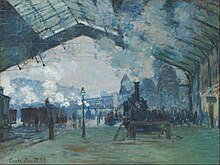
Trains can be sorted into types based on whether they haul passengers or freight (though mixed trains which haul both exist), past their weight (heavy rails for regular trains, lite rail for lighter rapid transit systems), by their speed, and by what class of track they use. Conventional trains operate on 2 rails, but several other types of track systems are also in utilize around the world.
Terminology
The railway terminology that is used to depict a train varies betwixt countries. The ii chief systems of terminology are International Matrimony of Railways terms in much of the earth, and Association of American Railroads terms in Northward America.[26] [27]
Trains are typically defined equally ane or more than locomotives coupled together, with or without cars. A collection of track vehicles may also be called a consist. A set of vehicles that are permanently or semi-permanently coupled together (such as the Pioneer Zephyr) is called a trainset. The term rolling stock is used to describe whatsoever kind of train vehicle.[27]
Components
Bogies
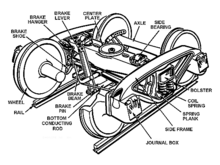
Bogies, also known in Northward America equally trucks, support the wheels and axles of trains. Trucks range from just 1 axle to as many as 4 or more. Ii axle trucks are in the widest utilize worldwide, as they are amend able to handle curves and back up heavy loads than unmarried axle trucks.[28]
Couplers
Train vehicles are linked to one another past diverse systems of coupling. In much of Europe, Republic of india, and South America, trains primarily apply buffers and chain couplers, while in the residual of the world knuckle couplers are used.[29] [30]
Brakes
Because trains are heavy, powerful brakes are needed to slow or stop trains, and because steel wheels on steel rails have relatively low friction, brakes must exist distributed among every bit many wheels as possible. Early trains could only be stopped by manually applied manus brakes, requiring workers to ride on elevation of the cars and apply the brakes when the train went downhill. Paw brakes are still used to park cars and locomotives, but the predominant braking system for trains globally is air brakes, invented in 1869 past George Westinghouse. Air brakes are applied at in one case to the entire railroad train using air hoses.[31]
Warning devices

This cab car includes a horn (superlative), a bell (top correct), headlights (above the door), nomenclature lights (cherry-red lights on side), and ditch lights (white lights on side)
For prophylactic and communication, trains are equipped with bells, horns, and lights.[32] [33] Steam locomotives typically use steam whistles rather than horns. Other types of lights may be installed on locomotives and cars, such as nomenclature lights, Mars Lights, and ditch lights.[34]
Cabs
Locomotives are in most cases equipped with cabs, also known as driving compartments, where a train driver controls the train'south operation.[35] They may likewise be installed on unpowered train cars known as cab or command cars, to permit for a train to operate with the locomotive at the rear.[36]
Operations
Scheduling and dispatching
To prevent collisions or other accidents, trains are oftentimes scheduled, and almost always are under the command of train dispatchers.[37] Historically, trains operated based on timetables; well-nigh rider trains go along to operate based on fixed schedules, though freight trains may instead run on an as-needed footing, or when enough freight cars are available to justify running a train.[38]
Maintenance

Simple repairs may exist done while a train is parked on the tracks, but more extensive repairs will exist washed at a motive ability depot.[39] Similar facilities exist for repairing damaged or defective train cars.[40] Maintenance of fashion trains are used to build and repair railroad tracks and other equipment.[41]
Coiffure
Train drivers, also known as engineers, are responsible for operating trains.[42] Conductors are in charge of trains and their cargo, and help passengers on rider trains.[42] Brakeman, also known as trainmen, were historically responsible for manually applying brakes, though the term is used today to refer to crew members who perform tasks such as operating switches, coupling and uncoupling train cars, and setting handbrakes on equipment.[42] Steam locomotives require a fireman who is responsible for fueling and regulating the locomotive'south burn and boiler.[42] On passenger trains, other crew members assist passengers, such every bit chefs to prepare food, and service attendants to provide food and drinks to passengers. Other passenger railroad train specific duties include passenger automobile attendants, who aid passengers with boarding and alighting from trains, answer questions, and continue railroad train cars clean, and sleeping car attendants, who perform similar duties in sleeping cars.[42]
Gauge
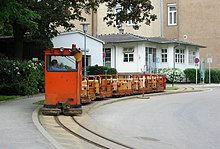
Around the world, diverse track gauges are in use for trains. In nearly cases, trains can only operate on tracks that are of the same gauge; where different gauge trains come across, it is known every bit a suspension of guess. Standard gauge, divers every bit ane,435 mm (4 ft 8.5 in) between the runway, is the virtually common approximate worldwide, though both broad-approximate and narrow-gauge trains are besides in apply.[43] Trains as well need to fit within the loading gauge profile to avoid fouling bridges and lineside infrastructure with this existence a potential limiting factor on loads such equally intermodal container types that may exist carried.[44]
Safety

Most derailments, such as this one in Switzerland, are pocket-size and practise not cause injuries or impairment.
Train accidents sometimes occur, including derailments (when a train leaves the tracks) and train wrecks (collisions betwixt trains). Accidents were more common in the early days of trains, when railway signal systems, centralized traffic control, and failsafe systems to forbid collisions were primitive or did not notwithstanding exist.[45] To prevent accidents, systems such as automated train end are used; these are failsafe systems that apply the brakes on a train if it passes a ruddy indicate and enters an occupied block, or if whatever of the railroad train's equipment malfunctions.[46] More advanced condom systems, such as positive train control, can also automatically regulate train speed, preventing derailments from entering curves or switches too fast.[47]
Mod trains have a very good safety record overall, comparable with air travel.[48] In the Usa between 2000 and 2009, train travel averaged 0.43 deaths per billion passenger miles traveled. While this was higher than that of air travel at 0.07 deaths per billion rider miles, it was as well far beneath the 7.28 deaths per billion passenger miles of motorcar travel.[49] In the 21st century, several derailments of oil trains caused fatalities, near notably the Canadian Lac-Mégantic rail disaster in 2013 which killed 47 people and leveled much of the town of Lac-Mégantic.[50]
The vast bulk of train-related fatalities, over 90 percent, are due to trespassing on railroad tracks, or collisions with route vehicles at level crossings.[51] Organizations such every bit Operation Lifesaver have been formed to ameliorate safe awareness at railroad crossings, and governments have also launched ad campaigns. Trains cannot stop quickly when at speed; fifty-fifty an emergency restriction application may still require more than a mile of stopping distance. As such, emphasis is on educating motorists to yield to trains at crossings and avoid trespassing.[52]
Motive ability

Before steam
The starting time trains were rope-hauled, gravity powered or pulled by horses.[2]
Steam
Steam locomotives work by using a boiler to heat water into steam, which powers the locomotive's pistons which are in plow connected to the wheels.[53] In the mid 20th century, nearly steam locomotives were replaced past diesel or electric locomotives, which were cheaper, cleaner, and more reliable.[54] Steam locomotives are still used in heritage railways operated in many countries for the leisure and enthusiast market.[55]
Diesel
Diesel fuel locomotives are powered with a diesel fuel engine, which generates electricity to bulldoze traction motors. This is known as a diesel–electric transmission, and is used on almost all diesels.[56] Diesel power replaced steam for a variety of reasons: diesel fuel locomotives were less complex, far more than reliable, cheaper, cleaner, easier to maintain, and more fuel efficient.[54]
Electric
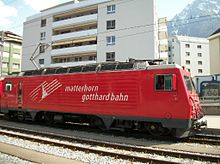
Electric trains receive their current via overhead lines or through a third rail electric organisation, which is then used to power traction motors that drive the wheels.[57] Electric traction offers a lower cost per mile of train operation but at a college initial cost, which can only exist justified on loftier traffic lines. Fifty-fifty though the cost per mile of structure is much college, electric traction is cheaper to operate thanks to lower maintenance and purchase costs for locomotives and equipment.[57] Compared to diesel locomotives, electric locomotives produce no direct emissions and accelerate much faster, making them better suited to rider service, especially underground.[57] [58]
Other types

Various other types of railroad train propulsion have been tried, some more successful than others.
In the mid 1900s, gas turbine locomotives were adult and successfully used, though almost were retired due to high fuel costs and poor reliability.[59]
In the 21st century, alternative fuels for locomotives are under evolution, due to increasing costs for diesel and a desire to reduce greenhouse gas emissions from trains. Examples include hydrail (trains powered past hydrogen fuel cells) and the employ of compressed or liquefied natural gas.[60] [61]
Train cars
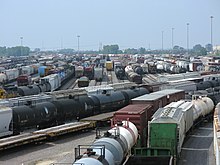
Train cars, likewise known as wagons, are unpowered rail vehicles which are typically pulled past locomotives. Many different types be, specialized to handle various types of cargo. Some mutual types include boxcars (also known as covered goods wagons) that carry a wide variety of cargo, flatcars (too known as flat wagons) which have flat tops to hold cargo, hopper cars which deport bulk commodities, and tank cars which acquit liquids and gases. Examples of more specialized types of train cars include bottle cars which agree molten steel,[62] Schnabel cars which handle very heavy loads, and refrigerator cars which acquit perishable goods.[63] [64]
Early on train cars were small and light, much similar early locomotives, but over time they have become larger as locomotives accept become more powerful.[62]
Rider trains

A passenger train is used to transport people forth a railroad line. These trains may consist of unpowered rider railroad cars (also known as coaches or carriages) hauled by one or more locomotives, or may be self-propelled; self propelled rider trains are known as multiple units or railcars. Passenger trains travel between stations or depots, where passengers may board and disembark. In most cases, passenger trains operate on a fixed schedule and have priority over freight trains.[65]
Passenger trains can be divided into brusque and long distance services.
Long altitude trains
Long distance rider trains travel over hundreds or even thousands of miles between cities. The longest passenger train service in the world is Russia's Trans-Siberian Railway betwixt Moscow and Vladivostok, a distance of 9,289 kilometers (5,772 mi).[66] In full general, long distance trains may take days to consummate their journeys, and stop at dozens of stations along their routes. For many rural communities, they are the only form of public transportation available.[67]
Brusque distance trains
Short distance or regional rider trains have travel times measured in hours or even minutes, as opposed to days. They run more oft than long distance trains, and are often used by commuters. Brusque distance passenger trains specifically designed for commuters are known every bit commuter track.[68]
Loftier speed trains

High speed trains are designed to be much faster than conventional trains, and typically run on their own carve up tracks than other, slower trains. The start loftier speed train was the Japanese Shinkansen, which opened in 1964.[69] In the 21st century, services such as the French TGV and German Intercity Limited are competitive with airplanes in travel fourth dimension over short to medium distances.[lxx]
A subset of high speed trains are higher speed trains, which bridge the gap between conventional and high speed trains, and travel at speeds betwixt the two. Examples include the Northeast Regional in the United States, the Gatimaan Express in Bharat, and the KTM ETS in Malaysia.
Rapid transit trains
A number of types of trains are used to provide rapid transit to urban areas. These are distinct from traditional passenger trains in that they operate more than oftentimes, typically do not share tracks with freight trains, and embrace relatively short distances. Many unlike kinds of systems are in use globally.[71]
Rapid transit trains that operate in tunnels below ground are known as subways, undergrounds, or metros. Elevated railways operate on viaducts or bridges above the ground, oftentimes on top of city streets. "Metro" may also refer to rapid transit that operates at ground level. In many systems, two or fifty-fifty all three of these types may exist on different portions of a network.
Trams
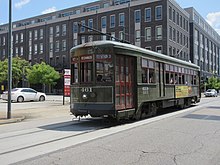
Trams, besides known in North America equally streetcars, typically operate on or parallel to streets in cities, with frequent stops and a loftier frequency of service.[72]
Light rail
Calorie-free rails is a catchall term for a diversity of systems, which may include characteristics of trams, rider trains, and rapid transit systems.[72]
Specialized trains
There are a number of specialized trains which differ from the traditional definition of a train every bit a set of vehicles which travels on two rails.
Monorail

Monorails were adult to meet medium-demand traffic in urban transit, and consist of a railroad train running on a unmarried rail, typically elevated. Monorails stand for a small proportion of the train systems in use worldwide. Almost all monorail trains use linear induction motors.[73] [74]
Maglev
To achieve much faster performance over 500 kilometers per hour (310 mph), maglev technology has been researched since the early on 20th century.[75] The technology uses magnets to levitate the train above the runway, reducing friction and allowing college speeds.[76] The outset commercial maglev train was an airdrome shuttle introduced in 1984 at Birmingham Airport in England.[77]
The Shanghai Maglev Railroad train, opened in 2003, is the fastest commercial train service of whatsoever kind, operating at speeds of up to 430 km/h (270 mph).[78] Japan's L0 Serial maglev holds the tape for the earth'due south fastest train ever, with a pinnacle speed of 603.0 kilometers per hour (374.seven mph).[79] Maglev has not yet been used for inter-urban center mass transit routes, with merely a few examples in use worldwide as of 2021.[78]
Mine trains
Mine trains are operated in large mines and carry both workers and appurtenances. They are usually powered by electricity, to prevent emissions which would pose a health risk to workers underground.[fourscore]

A preserved armored train
Militarized trains
While they have long been important in transporting troops and military machine equipment, trains take occasionally been used for direct combat. Armored trains take been used in a number of conflicts, as take railroad based artillery systems.[81] [82] Railcar-launched ICBM systems accept as well been used by nuclear weapon states.[83]
Rack railway
For climbing steep slopes, specialized rack railroads are used. In order to avoid slipping, a rack and pinion arrangement is used, with a toothed rail placed between the ii regular runway, which meshes with a bulldoze gear under the locomotive.[84]
Funicular
Funiculars are also used to climb steep slopes, but instead of a rack use a rope, which is attached to two cars and a pulley.[85] The two funicular cars travel upwardly and down the gradient on parallel sets of runway when the caster is rotated. This blueprint makes funiculars an efficient means of moving people and cargo up and down slopes.[86] The earliest funicular railroad, the Reisszug, opened around 1500.[86]
Freight trains
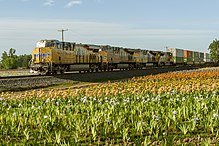
Freight trains are defended to the transport of cargo (too known equally goods), rather than people, and are made up of freight cars or wagons. Longer freight trains typically operate between classification yards, while local trains provide freight service between yards and individual loading and unloading points along railroad lines.[87] Major origin or destination points for freight may instead be served by unit of measurement trains, which exclusively carry one type of cargo and motility directly from the origin to the destination and back without any intermediate stops.[88]
Under the right circumstances, transporting freight by railroad train is less expensive than other modes of transport, and also more free energy efficient than transporting freight by road. In the United states, railroads on average moved a ton of freight 702 kilometers (436 mi) per gallon of fuel, as of 2008, an efficiency four times greater than that of trucks.[89] [90] The Environmental and Energy Study Institute estimates that train transportation of freight is between one.9 and 5.5 times more efficient than by truck, and as well generates significantly less pollution.[57] Rail freight is most economic when goods are being carried in majority and over big distances, but information technology is less suited to brusque distances and small loads.[90] With the advent of containerization, freight runway has become part of an intermodal freight network linked with trucking and container ships.[91]
The principal disadvantage of track freight is its lack of flexibility and for this reason, rail has lost much of the freight business to route competition. Many governments are trying to encourage more freight back on to trains because of the community benefits that information technology would bring.[92]
Cultural affect

From the dawn of railroading, trains have had a significant cultural impact worldwide. Fast train travel made possible in days or hours journeys which previously took months. Transport of both freight and passengers became far cheaper, allowing for networked economies over large areas.[93] Towns and cities along railroad lines grew in importance, while those bypassed declined or even became ghost towns.[93] [94] Major cities such every bit Chicago became prominent because they were places where multiple train lines met.[95] In the United States, the completion of the first transcontinental railroad played a major role in the settling of the western part of the nation by not-indigenous migrants and its incorporation into the rest of the country.[96] The Russian Trans-Siberian Railway had a similar impact by connecting the vast country from east to west, and making travel beyond the frozen Siberia possible.[97]
Trains have long had a major influence on music, fine art, and literature.[98] Many films heavily involve or are assail trains.[99] Toy railroad train sets are commonly used by children, traditionally boys.[100] [101] Railfans are found effectually the world, along with hobbyists who create model train layouts.[102] Train enthusiasts mostly take a positive relationship with the railroad manufacture, though sometimes cause issues past trespassing.[102]
See besides
- List of railway companies
- Lists of named passenger trains
- Lists of rail accidents
- Overview of train systems by state
References
- ^ "Definition of train (noun) in Meaty OED". AskOxford.com. Oxford Academy Press. Archived from the original on 26 May 2005. Retrieved 18 March 2008.
- ^ a b c Herring 2000, p. 8.
- ^ Herring 2000, p. ix.
- ^ Herring 2000, pp. ix–xi.
- ^ Herring 2000, p. 12.
- ^ Herring 2000, p. 12-13.
- ^ a b Herring 2000, p. fourteen-15.
- ^ a b c Herring 2000, p. 15.
- ^ Herring 2000, p. 16-17.
- ^ Herring 2000, p. 17.
- ^ a b Herring 2000, p. 20-21.
- ^ Schafer, Mike (1998). Vintage diesel fuel locomotives. Osceola, WI: Motorbooks International. pp. x–12. ISBN0-7603-0507-2. OCLC 38738930.
- ^ Herring 2000, p. xx-22.
- ^ Herring 2000, p. 20-23.
- ^ Herring 2000, p. 22-24.
- ^ a b Herring 2000, p. 23-24.
- ^ Herring 2000, p. 22-23.
- ^ Phillips, Don; French, Howard Due west. (vi November 2005). "Last dandy steam railroad nears stop of line". The New York Times. ISSN 0362-4331. Retrieved 6 November 2021.
- ^ Herring 2000, p. 23.
- ^ a b Herring 2000, p. 23-25.
- ^ Herring 2000, p. 25.
- ^ "Runway - Fuels & Technologies". IEA. seven January 2022. Retrieved 23 January 2022.
{{cite spider web}}: CS1 maint: url-condition (link) - ^ "The Future of Runway – Analysis". IEA. Jan 2019. Retrieved 5 Nov 2021.
{{cite spider web}}: CS1 maint: url-status (link) - ^ Bonfire, Jim (two Jan 2020). "Will Brusk-Haul Track Intermodal Always Work?". Railway Age . Retrieved 5 November 2021.
{{cite web}}: CS1 maint: url-status (link) - ^ Associated Press (six August 2002). "Shore Line East ridership is upward". Record-Journal . Retrieved v Nov 2021.
- ^ "Terminology". UIC - International union of railways . Retrieved five November 2021.
{{cite web}}: CS1 maint: url-status (link) - ^ a b "CSX.com - Railroad Dictionary". csx.com . Retrieved v Nov 2021.
- ^ Okamoto, Isao (Dec 1998). "How Bogies Work" (PDF). Nippon Railway & Ship Review . Retrieved four November 2021.
{{cite web}}: CS1 maint: url-condition (link) - ^ "Mechanical focus: couplers". Railway Age. 27 Dec 2016. Retrieved 4 Nov 2021.
- ^ Wagner, Simon; Cole, Colin; Spiryagin, Maksym (i June 2021). "A review on pattern and testing methodologies of modern freight train draft gear system". Railway Applied science. 29 (2): 127–151. doi:10.1007/s40534-021-00237-y. ISSN 2662-4753. S2CID 236335052.
- ^ Herkewitz, William (10 July 2013). "Understanding a Runaway Train: How Exercise Air Brakes Piece of work?". Popular Mechanics . Retrieved 4 Nov 2021.
- ^ "Railroad train Horn". BNSF Railway . Retrieved iv November 2021.
{{cite web}}: CS1 maint: url-status (link) - ^ Weart, Ray (10 October 2019). "Ask Trains: What are the rules on when locomotive bells should ring?". Trains . Retrieved 4 Nov 2021.
{{cite web}}: CS1 maint: url-status (link) - ^ Schauer, David C. (1 May 2006). "Locomotive classification lights". Trains. Archived from the original on 25 March 2021. Retrieved iv November 2021.
- ^ Wiedrich, Bob (27 May 1990). "ALL THE COMFORTS OF A-LOCOMOTIVE CAB". Chicago Tribune . Retrieved 5 November 2021.
{{cite web}}: CS1 maint: url-status (link) - ^ "Comet I Commuter Coaches". Whippany Railway Museum . Retrieved 5 November 2021.
{{cite web}}: CS1 maint: url-condition (link) - ^ "How Does Train Dispatching Work?". www.upwards.com. 23 March 2021. Retrieved four Nov 2021.
{{cite web}}: CS1 maint: url-condition (link) - ^ Lester, David C. (1 February 2018). "Scheduling freight trains". Trains . Retrieved 5 Nov 2021.
{{cite web}}: CS1 maint: url-status (link) - ^ Guss, Chris (1 March 2018). "Where diesels go to the doctor". Trains . Retrieved v Nov 2021.
{{cite web}}: CS1 maint: url-status (link) - ^ Luther, Darrel (22 September 2014). "Maintaining Railcars". Waste Advantage Magazine . Retrieved five November 2021.
{{cite web}}: CS1 maint: url-status (link) - ^ Solomon, Brian (2001). Railway maintenance equipment. Osceola, Wis.: MBI Pub. Co. pp. 57–59. ISBN0-7603-0975-2. OCLC 46976669.
- ^ a b c d e Sperandeo, Andy (one May 2006). "The people who work on trains". Trains . Retrieved 4 November 2021.
{{cite web}}: CS1 maint: url-status (link) - ^ Hilton, George W. (1 May 2006). "A history of runway judge". Trains . Retrieved 6 November 2021.
{{cite web}}: CS1 maint: url-status (link) - ^ Burroughs, David (15 October 2018). "Network Rail to increase loading gauge on Doncaster – Immingham Line". International Railway Journal. Archived from the original on 8 November 2021. Retrieved viii November 2021.
- ^ McDonald, Charles Westward. (August 1993). "The Federal Railroad Safe Program" (PDF). Federal Railroad Administration . Retrieved 5 November 2021.
{{cite web}}: CS1 maint: url-status (link) - ^ "Meriden In Safety Zone - New Train Finish System Installed". The Meriden Daily Journal. Meriden, Connecticut. 1 September 1925. p. 4. Retrieved 20 Jan 2022.
- ^ "Positive Train Control (PTC)". Federal Railroad Administration. 9 September 2021. Retrieved 20 Jan 2022.
{{cite web}}: CS1 maint: url-condition (link) - ^ Elliott, Christopher (24 May 2015). "Amtrak 188 crash: How condom are America'due south trains?". Fortune . Retrieved vi November 2021.
{{cite web}}: CS1 maint: url-status (link) - ^ Ingraham, Christopher (14 May 2015). "The safest — and deadliest — ways to travel". The Washington Post . Retrieved 5 Nov 2021.
{{cite news}}: CS1 maint: url-status (link) - ^ Murphy, Jessica (nineteen January 2018). "Lac-Megantic: The runaway railroad train that destroyed a town". BBC News . Retrieved 6 November 2021.
- ^ "Highway-Track Grade Crossing Condom and Trespass Prevention | FRA". railroads.dot.gov . Retrieved 6 November 2021.
- ^ "Terminate. Trains Can't. Railroad Crossing". National Highway Traffic Safety Administration . Retrieved six November 2021.
{{cite web}}: CS1 maint: url-status (link) - ^ McGonigal, Robert Southward. (1 May 2006). "How a steam locomotive works". Trains . Retrieved 5 November 2021.
{{cite web}}: CS1 maint: url-status (link) - ^ a b Nilsson, Jeff (11 May 2013). "Why Y'all Don't Come across Steam Locomotives Anymore". The Sat Evening Postal service . Retrieved five November 2021.
{{cite web}}: CS1 maint: url-status (link) - ^ "Minor and Heritage Railways". orr.gov.uk. Office of Rail and Road. Archived from the original on 22 February 2018. Retrieved 4 November 2021.
- ^ "Diesel Electrical Locomotives". edisontechcenter.org. 2014. Retrieved 5 Nov 2021.
{{cite web}}: CS1 maint: url-condition (link) - ^ a b c d Nunno, Richard (30 May 2018). "Electrification of U.Southward. Railways: Pie in the Sky, or Realistic Goal? | Article | EESI". world wide web.eesi.org . Retrieved 1 November 2021.
{{cite spider web}}: CS1 maint: url-status (link) - ^ Hickman, Leo (16 July 2012). "How dark-green are electric trains?". The Guardian . Retrieved 5 November 2021.
{{cite spider web}}: CS1 maint: url-status (link) - ^ "About Gas Turbine Locomotives". www.upwards.com . Retrieved v November 2021.
- ^ Clinnick, Robert (21 October 2021). "Worldwide hydrogen projects gain traction". International Railway Journal . Retrieved seven November 2021.
{{cite web}}: CS1 maint: url-status (link) - ^ Vantuono, William C. (one Nov 2021). "CP: Light-green 'Gas 'n Become' Gets Grant". Railway Age . Retrieved 7 Nov 2021.
{{cite web}}: CS1 maint: url-status (link) - ^ a b Schafer, Mike (1999). Freight railroad train cars. Mike McBride. Osceola, Wis.: MBI Pub. pp. 11–13, 93, 95. ISBN0-7603-0612-v. OCLC 41002704.
- ^ "Runway Auto Types Defined". www.up.com . Retrieved 5 November 2021.
- ^ Vantuono, William C. (fourteen June 2012). "Kasgro builds "World's Largest Railroad Motorcar"". Railway Age . Retrieved 5 November 2021.
{{cite web}}: CS1 maint: url-condition (link) - ^ "Freight Delays and Your Amtrak Service". www.amtrak.com . Retrieved v November 2021.
- ^ Warren, Katie (3 January 2020). "I rode the legendary Trans-Siberian Railway on a 2,000-mile journey across 4 time zones in Russian federation. Here's what it was like spending l hours on the longest train line in the world". Concern Insider . Retrieved 4 Nov 2021.
{{cite spider web}}: CS1 maint: url-status (link) - ^ Jaffe, Eric (xviii April 2013). "3 Reasons to Keep Amtrak's Long-Distance Trains Running". Bloomberg . Retrieved 5 November 2021.
{{cite spider web}}: CS1 maint: url-condition (link) - ^ Zipper, David (30 April 2020). "Volition Commuters Always Go Back to Commuter Trains?". Bloomberg . Retrieved 5 Nov 2021.
{{cite web}}: CS1 maint: url-condition (link) - ^ Herring 2000, p. 134-135.
- ^ Bachman, Justin; Fan, Richard; Cannon, Christopher (9 January 2018). "Scout Out, Airlines. High Speed Rails Now Rivals Flying on Key Routes". Bloomberg . Retrieved 5 Nov 2021.
{{cite spider web}}: CS1 maint: url-status (link) - ^ Herring 2000, p. 138-139.
- ^ a b Kobie, Nicole (4 April 2018). "Trams are great for metropolis transport – why doesn't the UK have more?". Wired UK. ISSN 1357-0978. Retrieved 5 November 2021.
- ^ "Linear Motor Driven System". Hitachi-Rail.com. Hitachi, Ltd. 2013. Archived from the original on 30 September 2018. Retrieved 23 June 2019.
- ^ "Monorail". RailSystem.internet. 2015. Retrieved 23 June 2019.
- ^ Boslaugh, Sarah E. "maglev | Facts, Functioning, & Systems". Encyclopaedia Britannica . Retrieved xv Jan 2022.
{{cite spider web}}: CS1 maint: url-status (link) - ^ "How Maglev Works". Energy.gov. 24 June 2016. Retrieved 5 November 2021.
{{cite web}}: CS1 maint: url-status (link) - ^ "Birmingham Airport'south quondam Maglev railroad vehicle to be sold". BBC News. 17 November 2010. Retrieved 5 Nov 2021.
- ^ a b Wang, Serenitie; Cripps, Karla (24 May 2019). "Cathay unveils 600km/h maglev train paradigm". CNN . Retrieved five Nov 2021.
{{cite web}}: CS1 maint: url-status (link) - ^ McCurry, Justin (21 April 2015). "Nippon's maglev train breaks world speed record with 600km/h exam run". the Guardian . Retrieved 5 November 2021.
{{cite web}}: CS1 maint: url-status (link) - ^ Moore, Paul (24 May 2020). "China'due south mines rolling out unmanned underground rail systems at a rapid step". International Mining . Retrieved 8 November 2021.
{{cite web}}: CS1 maint: url-status (link) - ^ "These are the incredible armored trains of Globe War I and World War II". Business concern Insider. 18 October 2015. Retrieved 5 November 2021.
{{cite web}}: CS1 maint: url-status (link) - ^ Harrison, Scott (11 June 2019). "From the Archives: fourteen-inch railroad guns fired most Oceanside". Los Angeles Times . Retrieved five November 2021.
{{cite spider web}}: CS1 maint: url-condition (link) - ^ Mizokami, Kyle (27 February 2017). "All Aboard Russia's Nuclear Weapon Apocalypse Railroad train". Popular Mechanics . Retrieved v November 2021.
- ^ Ellis, Fred; Frick, Martin R. (24 May 1976). "The Pike's Summit Cog Railway Colorado Springs, Colorado: A National Historic Mechanical Technology Landmark" (PDF). American Society of Mechanical Engineers . Retrieved 5 November 2021.
{{cite web}}: CS1 maint: url-status (link) - ^ "What Is a Funicular Railway". Incline Railway . Retrieved v November 2021.
- ^ a b Harley-Trochimczyk, Anna (7 July 2009). "The Fun of Funiculars". USC Viterbi Schoolhouse of Engineering . Retrieved 5 November 2021.
{{cite web}}: CS1 maint: url-status (link) - ^ "Freight Railroad Realignment Feasibility Written report Summary" (PDF). National Uppercase Planning Commission. April 2007. p. 8. Retrieved viii November 2021.
{{cite web}}: CS1 maint: url-condition (link) - ^ Johnson, Art (13 March 1983). "Unit train rolling fast in grain trade". The Spokesman-Review . Retrieved 5 November 2021.
- ^ Jackson, Brooks (1 July 2008). "Fuel Efficient Freight Trains?". FactCheck.org . Retrieved one November 2021.
- ^ a b "Freight Rail Overview | FRA". railroads.dot.gov . Retrieved ane Nov 2021.
- ^ Stagl, Jeff (June 2008). "Runway Insider-From dieselization to computerization to consolidation, freight railroads accept made manufacture-shaping strides". Progressive Railroading . Retrieved 6 November 2021.
{{cite web}}: CS1 maint: url-status (link) - ^ "Benefits of using Rail Freight" (PDF). Transport Scotland. 2017. Retrieved 5 November 2021.
{{cite web}}: CS1 maint: url-status (link) - ^ a b "The furnishings of the railways - Transport — canals and railways - National five History Revision". BBC Bitesize . Retrieved 6 Nov 2021.
- ^ Wolmar, Christian (25 September 2012). The Neat Railroad Revolution: The History of Trains in America. PublicAffairs. pp. 217–221. ISBN978-1-61039-180-1.
- ^ Koziarz, Jay (21 September 2017). "Transportation that built Chicago: The railroads". Curbed Chicago . Retrieved 21 January 2022.
- ^ "The Impact of the Transcontinental Railroad". American Feel. PBS. Retrieved 6 Nov 2021.
- ^ Beauchamp, Zack (5 October 2016). "The Trans-Siberian Railway reshaped earth history". Vox . Retrieved 7 November 2021.
- ^ "Chattanooga, Tennessee: Train Town (Instruction with Celebrated Places) (U.Due south. National Park Service)". www.nps.gov . Retrieved 6 November 2021.
- ^ Gilbey, Ryan (19 June 2015). "Runway record: why trains weave their way through the history of keen cinema". New Statesman . Retrieved 25 January 2022.
- ^ Leggett, Bob (2019). Toy trains : [1935-1975]. Oxford. ISBN978-1-78442-308-7. OCLC 1085144352.
- ^ Delamont, Sara (17 October 2021). The Folklore of Women: An Introduction. Routledge. pp. 38–41. ISBN978-1-000-46408-5.
- ^ a b "Tips for Railfans | Metra". metra.com . Retrieved 6 November 2021.
Bibliography
- Glancey, Jonathan (2005). The Train. Carlton Publishing Group. ISBN978-1-84442-345-3.
- Herring, Peter (2000). Ultimate Railroad train. Dorling Kindersley. ISBN0-7894-4610-iii. OCLC 42810706. OL 8155464M.
External links
Source: https://en.wikipedia.org/wiki/Train
0 Response to "Draw a 6 Hour Travel Time Circle Around Osceola Wisconsin"
Post a Comment